Solar: The Nitty Gritty

Have you ever gazed into the bright sun and wondered… how is that little ball going to heat my house (while the ultraviolet radiation burns holes in your retinas?)
Solar companies hype their panels as environmentally friendly, and they are somewhat. However, in today’s world, the term “green” brings different levels of scrutiny depending on your personal belief systems. I write this newsletter to generate unbiased information, and I hope you can form your own opinions from my content.
My first topic: photovoltaic solar panels.
Virtually all photovoltaic solar panels use crystalline silicon wafers. If you know anything about computer chips, you’ll recognize that material. Yes, a solar panel is basically a big old computer chip. In fact, silicon is used to create semiconductors for about 95 percent of all panels on the market (and yes, most computer chips). Silicon wafers are incredibly useful. When these silicon wafers interact with the sun, they shed electrons. (Ahem, this is how electricity happens.)
Obvioulsy, the solar panel alone can’t power your home… you also need glass coverings over the panels, plastic (hello insulator), and metal (conductor). Plastic is a petroleum product, but there are not too many other insulators available. You wouldn’t want electricity directly hitting your roof.
Now, you can’t just mine silicon wafers. Silica doesn’t form wafers in nature. It is mined out of sand as silicon dioxide (SiO2 for all you chemists — “white sandy crystals” for all you non-chemists like me), and processed into raw polysilicon (also known as “poly.”) It is then heated to more than 2500 degrees Fahrenheit (1371 Celsius or 1644 Kelvin) inside a special furnace sealed with argon gas. The silicon (now a molten liquid) is spun in a crucible and and formed into a metal crystal while it cools.
The crystal must then be cut down to size after being tested with chemicals and x-rays to make sure it’s “waferable.”
You might be wondering how they heat a furnace that hot. The answer: usually coal. There aren’t a lot of ways to make things that hot, and there are notably few ways that use renewables.
Now, before you start sifting the sand outside your house looking for white crystals, realize that geography matters, and not all white crystals are soon-to-be solar panels.
Most silica is produced by China. By a lot. The next-largest producer of silica? Russia. (Thank you Statista for the following chart).
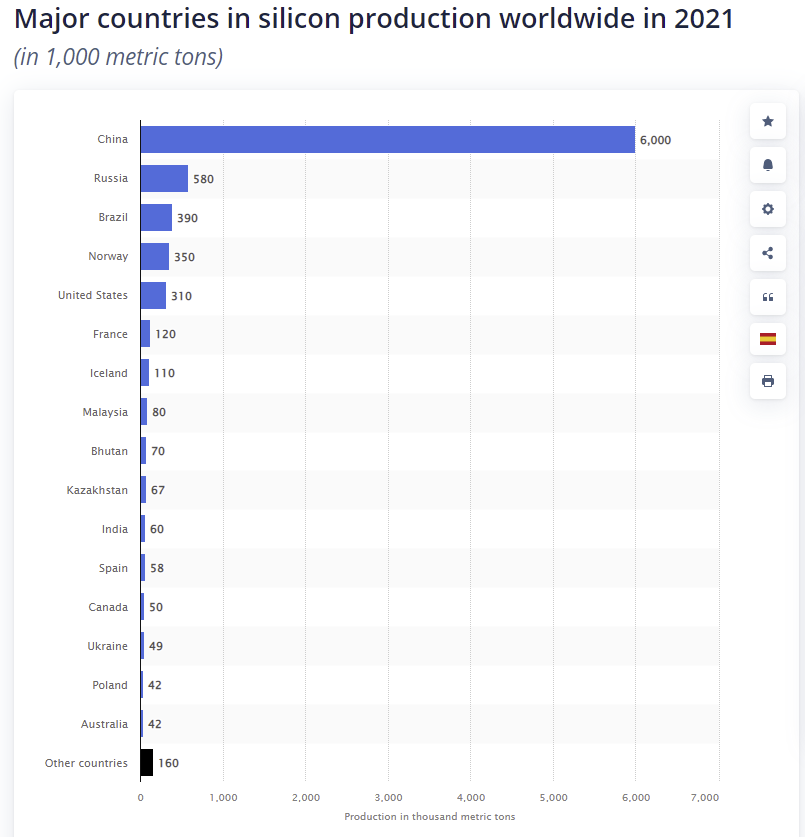
As I write this, those countries are not exactly on our list of Facebook friends, so one might be inclined to conclude that silica mines are a national security issue for the United States. Aside from a few friendly countries like Brazil and Norway, we have U.S. Silica. And… that’s basically it.
So there you have it. If you’re still reading, thank you. If not, then, well… I guess you won’t see this anyway.